
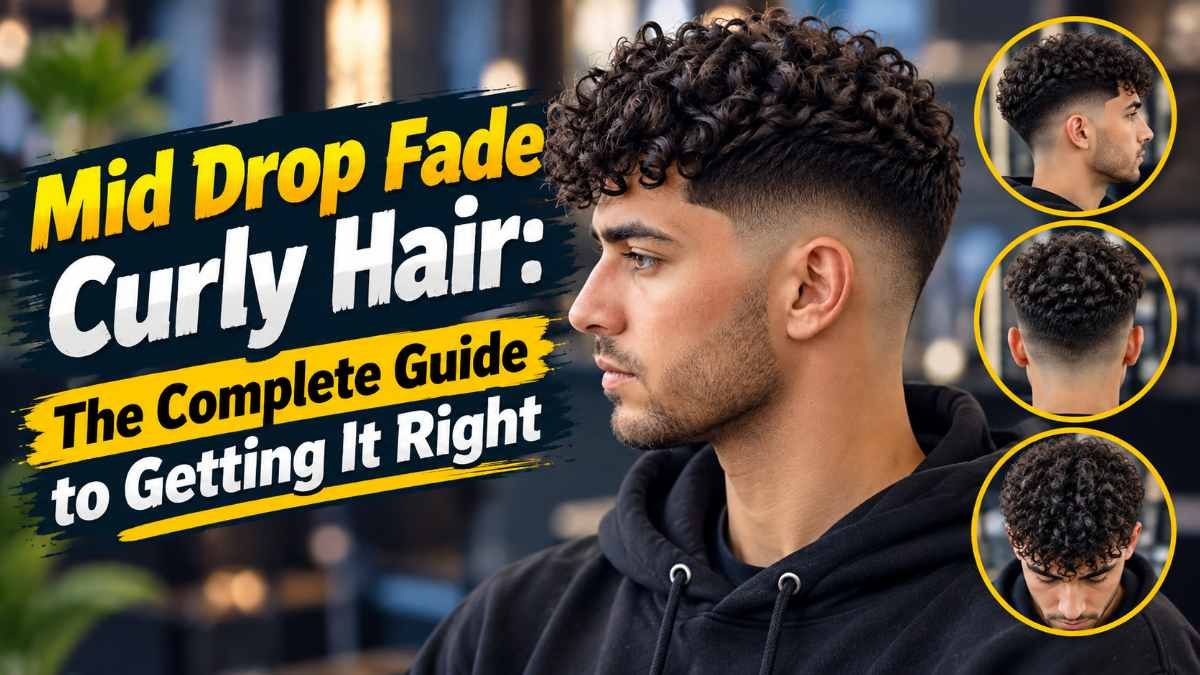

Curly hair and fades don’t always mix well at your average barbershop. A mid drop fade curly hair cut takes real skill, and getting it wrong means weeks of awkward growth. This guide breaks down everything you need to know, from curl types to daily styling, so you walk into your next appointment ready to get the cut you actually want.
Why It’s Different
A regular fade fades in a straight line around the head. A mid drop fade does something different. The fade line starts at the temple, then dips down behind the ear before curving back up toward the nape of the neck. That drop is what gives the style its name.
Now add curly hair into the mix. Straight hair lies flat and shows the fade line clearly. Curly hair springs, coils, and bounces. It doesn’t sit the same way twice. That means a curly hair fade needs a barber who understands how curls behave, not just someone who can run clippers in a straight line.
Here’s a simple comparison to show how the mid drop fade stacks up against other popular cuts:
| Fade Type | Where It Starts | Best For |
| High Fade | Above the temple | Short sides, bold contrast |
| Low Fade | Near the ear | Subtle, everyday look |
| Mid Fade | Between high and low | Balanced, versatile |
| Mid Drop Fade | Mid level, curves down behind ear | Curly and textured hair |
Barbers often recommend a mid fade curly hair cut over a high fade because it gives curls room to keep their natural shape on top while still framing the face with clean, faded sides. It’s a happy medium. You get contrast without losing volume.
A lot of guys also compare this cut to a burst fade taper haircut. Both styles use curved fade lines instead of straight ones, but a burst fade taper haircut usually circles around the ear in a half moon shape, while the drop fade continues down toward the neck. If you like the look of a burst fade taper haircut but want something that flows further down, the mid drop fade might be your answer.
Shrinkage by Curl Type
Here’s something a lot of first timers don’t think about: hair shrinkage. Curly hair looks shorter dry than it actually is when stretched out wet. If your barber doesn’t account for this, your cut can end up way shorter than you wanted.
Curly hair shrinkage happens because each curl coils up on itself. The tighter the curl, the more it shrinks. This matters a ton for a drop fade curly hair cut, since the top length needs to survive the shrinkage and still look balanced against the faded sides.
Here’s a rough breakdown by curl type:
| Curl Type | Curl Pattern | Average Shrinkage |
| Type 2A to 2C (wavy) | Loose S shape | 10 to 20 percent |
| Type 3A curls | Loose spirals | 20 to 30 percent |
| Type 3B curls | Springy corkscrews | 30 to 40 percent |
| Type 3C curls | Tight corkscrews | 40 to 50 percent |
| Type 4A coils | Tight S coils | 50 to 65 percent |
| Type 4B coils | Sharp Z pattern | 65 to 75 percent |
| Type 4C coils | Densely packed coils | 75 percent or more |
That’s a big range. A guy with tight curls and heavy curl shrinkage percentage needs a barber who leaves extra length up top. Otherwise a cut that looked perfect wet turns into a much shorter, tighter shape once it dries.
Quick tip: Always ask your barber to check your hair both wet and dry before cutting. A quality curly hair taper fade should account for both states, not just one.
The Transition Zone
The transition zone is where the faded sides meet the curly top. This is the trickiest part of the whole haircut, and honestly, it’s where most bad fades go wrong.
Think of it like blending two different textures into one smooth picture. The sides are short and tight from the clippers. The top is longer, curlier, and full of volume. If the barber rushes this part, you end up with a harsh line, sometimes called a “helmet look,” where the top sits like a hat plopped on the sides.
A good fade transition takes patience. Barbers who specialize in curly hair often use a mix of tools to get it right:
- Clippers with guards for the faded sides
- Shears for blending the mid section
- Scissor-over-comb technique to soften the line between fade and curls
- Curl-by-curl cutting on top to shape without flattening the natural curl pattern
A smooth soft fade blend doesn’t happen by accident. It takes a steady hand and a barber who slows down instead of rushing through with clippers alone.
Here’s a quote worth remembering from a longtime curly hair specialist barber in Chicago:
“Cutting curly hair is like sculpting, not trimming. You have to work with the curl, not against it.”
That mindset applies directly to the transition zone. Fighting the curl pattern with straight clipper lines almost always looks off. Working with it creates a faded sides look that flows naturally into the curls above.
Growing Out Between Cuts
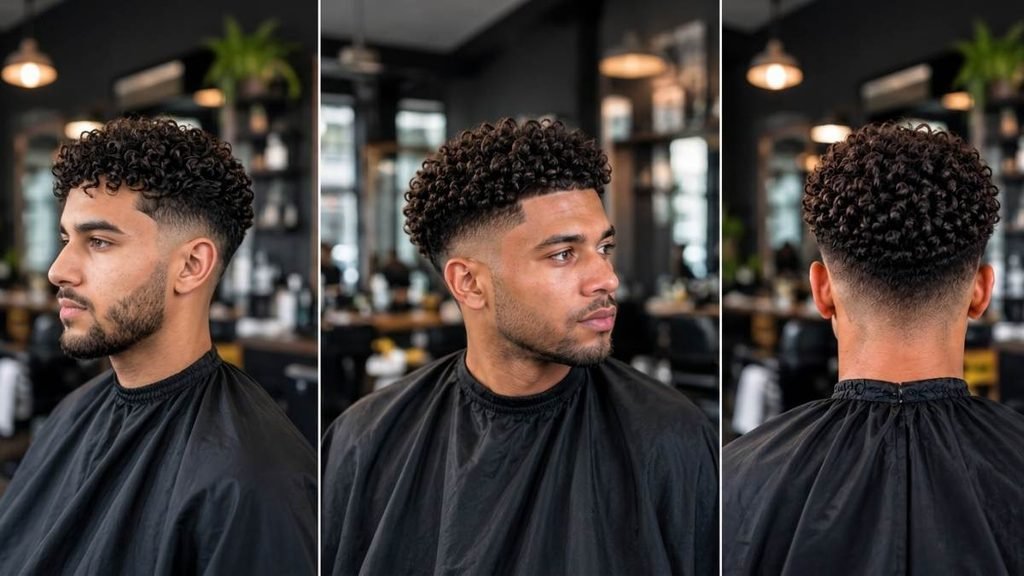
One thing curly haired guys need to know upfront: growth looks different on curls compared to straight hair. Because of shrinkage, a mid drop fade curly hair cut changes shape faster than people expect.
Here’s a rough timeline of what to expect:
Week 1
The fade sits crisp and sharp. Curls on top hold their defined shape from the fresh cut.
Week 2 to 3
The fade line starts to soften as new growth comes in. Curls on top may look slightly bigger as length returns.
Week 4 to 5
Regrowth along the sides begins to blur the fade. This is usually when guys start noticing frizz near the transition zone.
Week 6
Time for a touch up or a full recut, depending on how fast your hair grows and how sharp you like your fade.
A fade touch-up between full haircuts is a smart move. Most barbers can clean up just the sides and transition zone in fifteen to twenty minutes, which stretches out the time between full cuts and keeps the shape looking sharp.
If you’re someone who likes a crisp burst fade taper haircut look, touch ups matter even more, since that curved fade line grows out and softens faster than straight fade lines do.
Recommended Variations
There’s more than one way to wear a mid drop fade with curly hair. Here are some popular styles guys ask for:
- Mid drop fade with curly fringe – Longer curls fall forward over the forehead while the sides stay tight
- Mid drop fade with curly top fade – A fuller, rounder curly top paired with the dropped fade line
- Mid drop fade with hard part – A shaved line separates the fade from the curls for extra definition
- Mid drop fade with beard – Fade blends into a well groomed beard for a sharp, put together look
- Mid drop fade with curly quiff – Curls styled up and back for height and volume
Some guys also like pairing curl texture with a burst fade taper haircut style on the sides instead of a full drop, especially if they want something that circles tighter around the ear.
Case study: A barber in Atlanta shared that requests for curly top fades jumped noticeably over the past two years, especially among guys wanting a low maintenance style that still looks intentional. His advice? Bring a clear photo and be specific about how much curl volume you want to keep.
Learn More: Mid Drop Fade vs Mid Taper Fade: The Real Difference, Explained Simply
Mid Drop Fade Curly Hair Gallery
A picture says more than any description ever could when it comes to a curly hair fade styles haircut. Photos help you and your barber land on the exact same page before the clippers even turn on.
When browsing a gallery, pay attention to:
Curl type shown in the photo compared to your own
Curly hair density and curly hair volume, since a photo with thin curls won’t translate the same way onto thick, dense hair
Curly hair texture, fine versus coarse
Lighting and angle, since fades can look different depending on how the photo was taken
Organizing reference photos by category helps a lot:
| Category | What To Look For |
| By curl type | Match 3A, 3B, 3C, or 4A to 4C to your own pattern |
| By length | Compare top length before shrinkage |
| By skin tone | See how the fade contrast looks against your complexion |
What to Avoid
Not every choice works well for a curly fade haircut. Here are common mistakes that lead to disappointing results:
- Skipping the consultation. Jumping straight to clippers without discussing curl type and shrinkage sets you up for a bad surprise
- Cutting only with clippers on top. Curly tops usually need shears or curl-by-curl cutting, not just clipper guards
- Over-thinning curly hair. Thinning shears can strip volume and leave curls looking sparse and stringy
- Ignoring dry hair behavior. A cut that looks great wet can shrink up and look totally different once it dries
- Choosing a barber with no curly hair experience. Not every barber has practiced barber curly hair techniques, and it shows in the final result
A red flag worth watching for: if a barber tells you curly hair cuts the same as straight hair, that’s a sign to keep looking. Professional curly haircut work takes specific training that not every shop offers.
Styling It Day to Day
Keeping a mid drop fade curly hair cut looking fresh takes a bit of daily care, but nothing complicated. Here’s a simple routine:
Morning routine, three easy steps
- Lightly wet or spray curls with water to reactivate the pattern
- Apply a small amount of curl cream to damp curls, scrunching gently upward
- Air dry or use a diffuser for curly hair on low heat to boost curl definition without frizz
Product picks worth trying:
- Lightweight curl cream for daily definition without weighing curls down
- A light hold gel for extra hold on humid days
- Edge control or pomade to keep the faded sides looking crisp between visits
For wet versus dry curly haircut styling day to day, most guys find damp styling gives the best curl definition. Fully soaking wet curls can stretch out the pattern too much, while bone dry styling can lead to frizz and flyaways.
A quick refresh trick: spritz curls with water mixed with a touch of leave in conditioner on non wash days. This wakes up the defined curls without a full reset.
Curly and Not Sure What to Ask For?
Walking into a barbershop without the right words can lead to a cut you didn’t ask for. Here’s a simple script to bring with you:
What to say at the chair:
“I want a mid drop fade with a curly top. Please leave extra length on top since my curls shrink when dry. I’d like the transition zone blended softly, not sharp.”
Questions worth asking your barber:
- Do you have experience with curly haircut for men styles?
- Will you cut this wet, dry, or both?
- How much shrinkage should I expect once this dries?
- Can we blend the transition zone with shears instead of just clippers?
Bringing reference photos that match your exact curl pattern makes a huge difference. A photo of tight coils won’t translate the same way onto loose waves, so match the photo to your own curl pattern as closely as possible.
Frequently Asked
Does a mid drop fade work on all curl types?
Yes. From loose waves to tight coils, the style adapts. The main difference is how much length your barber leaves on top to account for shrinkage.
How often do I need a touch up?
Most guys go back every two to three weeks for a fade touch-up, with a full recut every five to six weeks depending on growth speed.
Will my curls look too short right after the cut?
They might look shorter than expected right after cutting, especially once fully dry. This is normal and part of natural curly hair shrinkage.
Can I get a mid drop fade with long curly hair on top?
Absolutely. Many guys keep more length up top for volume while still getting the dropped fade on the sides.
Is this a good first curly cut for beginners?
Yes, especially since it’s forgiving during growth. The dropped fade line softens naturally as hair grows, unlike sharper cuts like a straight burst fade taper haircut, which can look uneven as it grows out.
Does a burst fade taper haircut work with curly hair too?
It can, though the curved shape around the ear takes slightly more upkeep on curly hair compared to a mid drop fade, since curls grow into that curved line faster than straight fade lines.
Conclusion
A mid drop fade curly hair cut rewards patience and a skilled barber who understands curl type, shrinkage, and blending. Whether you lean toward this style or a burst fade taper haircut, the goal stays the same: healthy, defined curls paired with a sharp, well blended fade that actually works with your natural texture, not against it.

Emily Carter
Emily Carter is a hair and beauty writer who shares practical hair-care tips, hairstyle ideas, styling inspiration, and the latest hair trends. Through Fashquin, she aims to make hair content simple, useful, and enjoyable for readers looking for fresh ideas and everyday hair inspiration.
